So far, we have applied the ExpCR in the forward or left-to-right direction to complete the following type of D-equation:
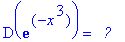
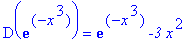
In this section, we will use the ExpCR in the reverse or right-to-left direction to complete the following type of reverse D-equation:
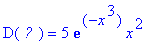
Note that if you compare this to the forward D-equation example above, you will see that we changed the factor of -3 to 5 so that the answer to this reverse D-equation would not be immediately obvious. To solve this reverse D-equation first we need to recognize that the ExpCR could possibly apply and to ask ourselves the question: "What could the right hand side have possibly come from?" A key observation is that if the ExpCR is going to apply, then we must have the the exponential expression with base e on the right hand side, also appearing on the left hand side. This idea will be used to help us make our first guess in finding the ultimate solution.
Unfortunately, the standard way most textbooks ask you to solve a reverse D-equation (also called 'anti-derivative' or 'indefinite integral') is with what is called 'integral notation' as follows:
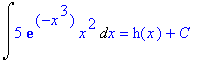
The elongated S is called the 'integral sign' and the 'dx' serves as a kind of punctuation. This notation is intended to anticipate hooking up with problems in which you compute the area under a curve, but at this stage it is merely notation that asks you to find a function with defining expression h(x) such that:
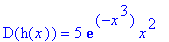
Notice that any such solution h(x) leads to infinitely many solutions of the form: h(x) + C, one for every constant real number C, since D(h(x) + C) = D(h(x)) + D(C) = D(h(x)) + 0. So, it is traditional to write the solution as h(x) + C, where h(x) is the solution you find by reversing the ExpCR, and C represents an arbitrary constant.
Example 1.
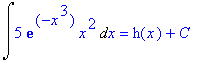
We will describe a four step heuristic process for finding h(x). First, translate the integral notation into a D-equation:

Second, guess h(x) by reversing the ExpCR:

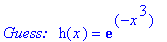


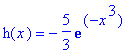
Third, adjust your guess, i.e. multiply by the constant you want and divide by the constant you don't want:
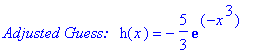


Fourth, write the final answer in the integral notation, substituting your final adjusted guess for h(x):
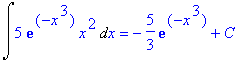
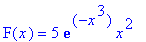
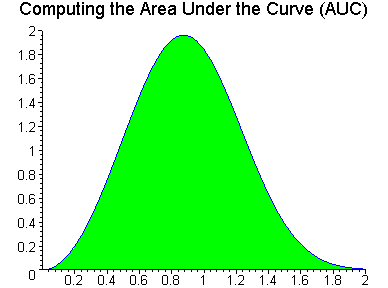
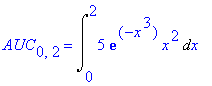
Now, use your h(x) to compute the area between the x-axis and the graph of F(x) from 0 to 2. (See the previous section on Area Functions for motivation and explanation.)


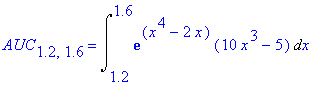
Example 2.
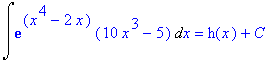
First, translate the integral notation into a D-equation:

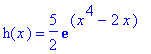
Second, guess h(x) by reversing the ExpCR:





Third, adjust your guess, i.e. multiply by the constant you want and divide by the constant you don't want:
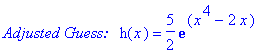


Fourth, write the final answer in the integral notation, substituting your final adjusted guess for h(x):

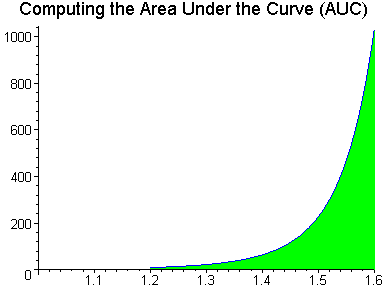
Now, use your h(x) to compute the area between the x-axis and the graph of F(x) from 1.2 to 1.6.