| Pharmacokinetics is the study of
the movement of drugs through the human system, from their introduction
by ingestion, injection, or other means, to elimination through excretion
or metabolism. It makes heavy use of compartment models as found in many
differential equations textbooks. Since almost all students take medications
from time to time, pharmacokinetics models are something they can easily
relate to.
For convenience many drugs are taken orally in the form of tablets. With some exceptions, these tablets [dosage forms] are designed to swell and disintegrate rapidly [release], causing the medication to dissolve quickly in the gastrointestinal tract [dissolution]. From there, the medication passes into the bloodstream [absorption], which delivers it to the sites at which it has therapeutic effect. Typically, the drug is removed from the bloodstream by filtration through the kidneys [excretion] or by metabolism in the liver. |
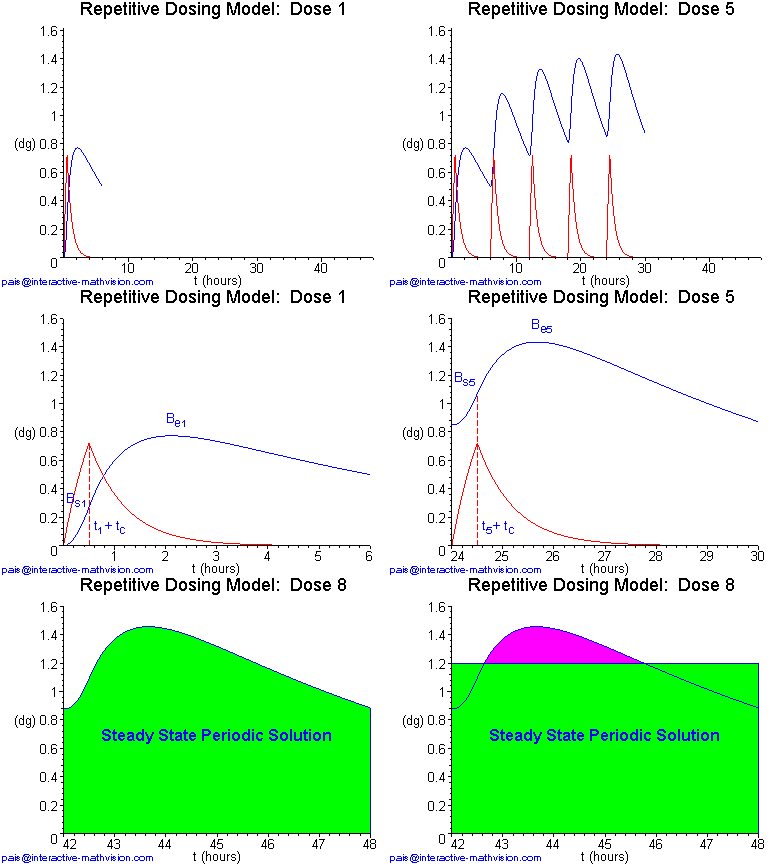
The basic model described below was introduced in Spitznagel [1] (and further discussed inYeargers et al. [2]) for a common decongestant assuming (essentially) a unit dose of 100 mg, a dosing interval of 6 hours, a uniform dissolution rate of 200 mg/hr, and consequent time for complete dissolution of each dose, one half hour. Furthermore, the rate constants k1 and k2 are determined by the half-lives of this decongestant in the GI tract and in the blood, respectively. Please note that the setup for the example in Panel 1 of the kinetigram definition below is the same as for this decongestant.
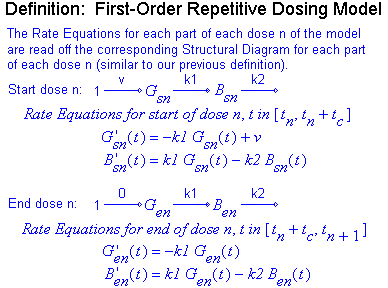
We begin with a bit of notation which you may wish to first skim briefly and then return to after viewing the kinetigram.
The main idea here is that, since dissolution is only turned on for
a part of each dosing interval, on each one we will need two functions
to model drug in the gut, and two functions to model drug in the blood.
Moreover, these functions will need to be appropriately glued together
both inside each dosing interval, and from interval to interval.
.
|
[1] E. Spitznagel. Two-Compartment Pharmacokinetic Models. C-ODE-E, Harvey Mudd College, Fall 1992. http://www.math.hmc.edu/codee/back-issues.html
[2] E. K. Yeargers, R. W. Shonkwiler, and J.
V. Herod. An Introduction to the Mathematics of Biology. Boston: Birkhauser,
1996.